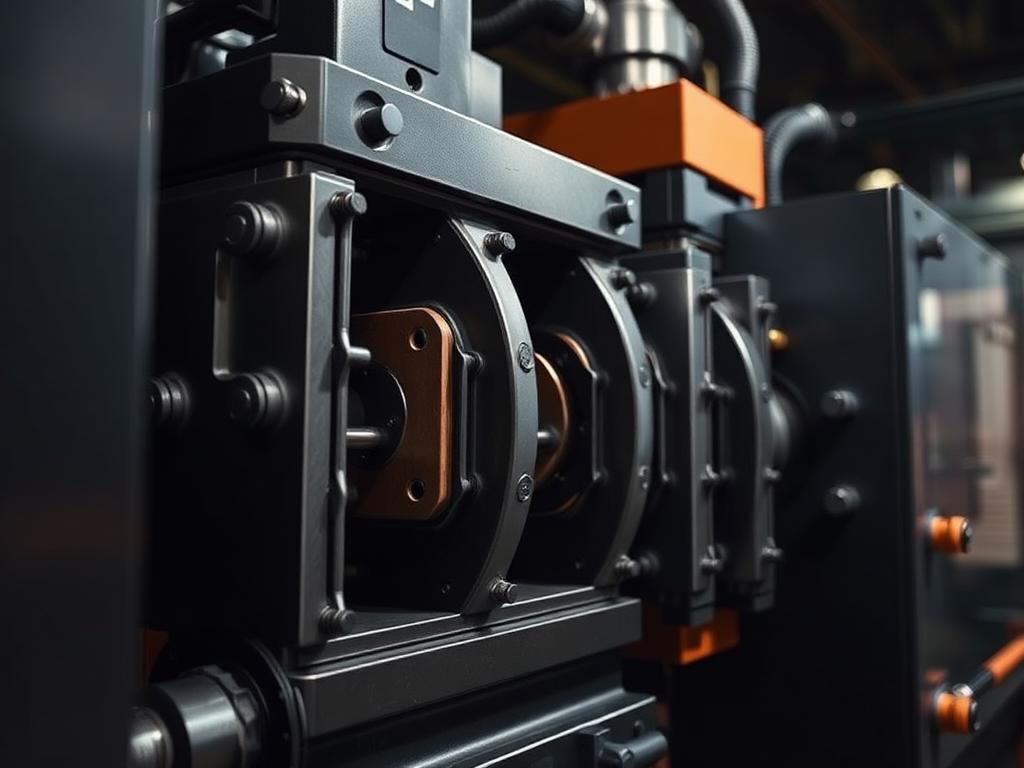
02 · Injection Molding
Plastic injection molding: from 0.5 g to 5 kg, one supplier
With clamping force from 90 to 1,100 tons, our injection molding park covers everything from small precision parts to large housings under one roof. Tooling is built in our in-house mold shop; parts are molded in an SPC-monitored process, tested in-line and delivered as assembled components.
A technical reply, not a sales one
Technical Envelope
90 to 1,100 tons: our range and our limit
90-0 t
Clamping force range
0.5 g-5 kg
Part weight range
0
Plants in İzmir and Manisa
IATF 16949
Quality management system certified since 2010
Clamping force (tonnage) is the force that keeps the mold closed during injection, and it answers one question directly: how large a part, with how many cavities, can be molded. Our park runs without gaps from 90 to 1,100 tons, an upper-mid, wide-spectrum position in contract molding: a 0.5 g connector body and a 5 kg main housing meet at the same supplier.
We state our limit with the same clarity: part classes that require clamping force above 1,100 tons (full bumper fascias, instrument panel carriers and similar very large surface parts) are outside our envelope. If technical review shows your part belongs to that class, we tell you in the first conversation instead of building a false expectation.
A wide tonnage range has two practical consequences: competitive piece prices on high-volume jobs through multi-cavity tooling, and tonnage headroom for low-flow materials such as glass-filled PA.
For the detailed capability matrix: Capabilities and Machine List
Tonnage Mapping
Where your part fits in our range
| Tonnage band | Typical part class | Typical shot weight |
|---|---|---|
| 90-150 t | Clips, connector bodies, caps, small technical parts | 0.5-50 g |
| 150-400 t | Brackets, enclosures, appliance internals, air deflectors | 50-300 g |
| 400-700 t | Interior trim, drawer and basket bodies, fan and HVAC housing elements | 300-1,000 g |
| 700-1,100 t | Large housings and casings, main appliance body components, structural carriers | 1,000-5,000 g |
Above 600 tons: the large part class
The 600 to 1,100 ton band covers the large housing and carrier class that sits above many contract molders' ceiling. Tooling investment and process risk grow in this band, which is exactly where an in-house mold shop and same-roof revisions save the most schedule time.
Material Range
Polymers we process and their typical applications
| Polymer | Typical application |
|---|---|
| PP | Interior trim, containers, hinged housings, air ducts |
| PE | Caps, technical housings, impact-resistant parts |
| ABS | Visible panels, housings, paintable and platable parts |
| PA / PA6 / PA66 (including glass-filled) | Engine bay brackets, fan blades, connectors, parts under thermal load |
| PBT | Electrical and electronic housings, connectors, dimensionally stable parts |
| POM | Gears, clips, sliding mechanism parts, low-friction elements |
| PC | Transparent covers, lenses, impact-resistant visible parts |
| TPE | Seals, grip surfaces, vibration-damping elements (via overmolding) |
| PS | Appliance internals, shelves, economical rigid bodies |
In automotive programs the material usually arrives as an OEM specification; our job is to mold that grade consistently within its processing window. Glass-filled and low-flow materials demand higher clamping force for the same part, so a park reaching 1,100 tons also means material flexibility.
Insert Molding and Overmolding
Assembly that finishes inside the mold
Insert molding
Metal components such as nuts, pins, bushings or stampings are placed in the mold and overmolded with plastic. It eliminates a downstream assembly step, and joint strength exceeds screwed connections.
Overmolding
A second material, most often TPE, is molded over a rigid substrate. Integrated seals, soft grip surfaces, vibration damping; the separate gasket assembly operation leaves your line.
Both capabilities serve the same goal: parts arrive at your line more finished, with fewer operations left to do.
Its Place in the Chain
Injection molding sits at the center of one accountability chain
Your injection mold is designed and built at our group company KAMAS; mold flow analysis runs before steel is cut, and first samples are measured on CMM. In serial production, molded parts are ultrasonically welded, leak tested and shipped as assembled components under the same roof where needed. When a tooling revision is required, the part does not travel between suppliers; the decision and the intervention stay with one project team.
Quality Integration
Quality assured by the process, not by sorting
SPC-monitored production
Critical dimensions are tracked with statistical process control against defined Cpk targets at approval and in serial production.
In-line laser dimensional control
Critical dimensions verified contact-free and operator-independent; your incoming inspection load goes down.
Batch traceability
Every batch is traceable back through material and process records.
IATF 16949 framework
Our quality management system has been certified since 2010; automotive programs run with APQP planning, PPAP approval files and 8D problem solving.
RFQ
Send your STEP file and estimated annual volume; our engineering team will come back with a technical assessment covering tonnage, cavitation and material for your part.
A technical reply, not a sales one